They could not kill him — you cannot kill the dark. So they shattered him and cast him into the chasm at the bottom of the world, and raised nine Lights over the grave. Ten thousand years on, the seal is failing, and the Silt is rising city by city.
At the dawn there were two, and they were opposites: Luma, the light, and Noctra, the dark. They parted, and went their own ways. Everything that has ever happened in Aetheris is those two, playing out to the eleventh hour.
Life, growth, warmth. Luma stayed in the world above and raised the living world — the green, the beasts, the people, and the cities they built.
And when the dark rose, Luma left behind the one thing it cannot cross: the Lights. While a Light burns, the Silt cannot take that ground. Nine still burn, and they are all that holds the world.
Noctra went down into the deep, alone, and found the dark arts, and fed on them, century after century, until nothing was left of it but hunger. It became Noctharion — the Hollow King.
What leaks out of him is the Silt: it kills what it touches and raises the body as a beast. He wants the whole living world dead, and himself in every part of it.
Luma, the light, and Noctra, the dark. In the beginning Noctra was only the night to that day — necessary, not yet evil.
They parted. Luma stayed above and tended the living world. Noctra went down into the deep, alone, and there it found the dark arts, and began to feed on them.
Century by century, feeding on power it was never meant to touch, Noctra hollowed itself out from the inside — until there was nothing left but appetite and hate.
That thing has a name now. Noctharion. The Hollow King. He wants the world dead and himself in every part of it, and there is no wound in him to heal and no bargain to strike.
City after city fell. The Silt ran ahead of him like a tide — killing the living and standing their bodies back up as beasts, blackening the forests, throwing up the grasping vines.
And he did not come alone. He went to nine great kings with offers — power, life without end — and one by one they took it, and it hollowed them into crowned wraiths bound to his will: the Vaelkyrr, the Deaf Kings.
When a Light goes out and the Silt floods in, the vines erupt and drag everyone beneath the earth. In a single night a city of thousands is gone — empty streets, open doors, the washing still on the line.
But they are not dead. They are strung up in the roots, in the dark, alive — and he drinks the life from them, drop by drop. They are his battery, and every one makes him stronger.
It looked like the end of the world. So the realms set down ten thousand years of quarrels and stood together — the bravest warriors the world ever made — and did the only thing left. They could not kill him, so they shattered him.
They broke his body and cast the pieces down into the great chasm at the bottom of the world, beneath Umbraxis, and over the grave they raised the Lights — Luma's fire, the one thing the Silt cannot cross.
It held for ten thousand years. There were more Lights once. The ones that went out are the realms that fell.
The Silt is leaking up. The Hollowing is spreading, city to city. Myrra fell, and Thaeron, and Veld — their Lights went out and the dark took them, and their people hang in the roots below.
And with every soul strung beneath the world, Noctharion grows stronger and the seal breaks faster. Nine Lights between him and everything. That is why the danger is now, and not in a hundred years.
At the dawn there were two powers: Luma, the light — and Noctra, the dark.
One of them went hungry.
Noctra went down into the deep and fed on the dark arts, century after century, until there was nothing left of it but hunger. It became Noctharion — the Hollow King.
He was never a man. There is nothing to reason with and nothing to understand. He is evil, the oldest and purest kind, and he wants the whole living world dead and himself in every part of it.
His corruption seeps up through the earth as the Silt. It does not empty you. It kills you, and raises your body as a beast. Your own dead come back wearing fangs.
It takes people, animals, even the plants — which blacken and grow the grasping vines that carry it. A hollowed realm is not empty. It is a hunting ground.
Thirteen cities in true 3D — turn the world in your hands. Tap any city for its story, its place in the war, and its theme, each one quoting the same four-note motif. Play the Chronicle of how the world came undone. And flip the world over into the deep — where the fallen realms hang inverted in the roots, strung in the dark and drained.
Open the mapOn a slow connection? Open the lighter map.
Each city is a gravity well that shapes speech, silence, and what a person is allowed to become. The city a bud comes from is why they are the way they are.
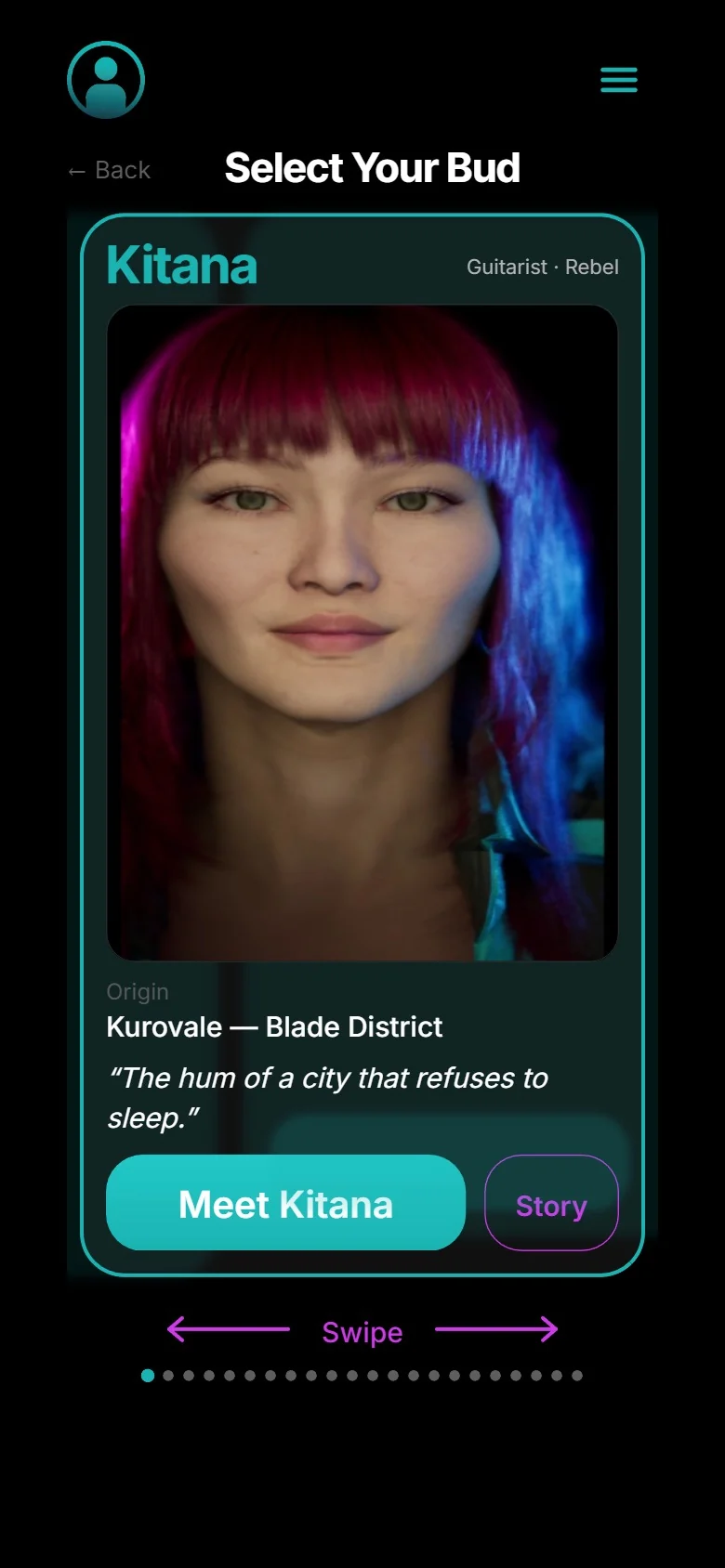
Stacked architecture, exposed cabling, illegal venues glowing against perpetual night. Music is the city's pulse: weaponised and fiercely protected. Its Light still burns, and the noise is how it holds — a city that will not go silent while the dark climbs toward it.
Eye contact is a challenge. Silence means tension. Loudness is survival.
Dark stone and precise geometry. Restraint above all. Emotion isn't forbidden here, only controlled. Its Light holds, and its discipline is a blade the city keeps turned toward the deep.
Speaking less earns respect. Honour outweighs mercy.
Floating structures and radiant stone. Knowledge is currency. Calm is dominance. Authority comes from understanding, not force. It keeps the record of every soul in every realm — every name the Silt has not yet taken.
Silence is respect. Rushed speech is weakness.
The imperial heart, where the Empress-Consul holds court. She is the nerve of the whole alliance — a symbol carried by people who have never met the woman behind it, and the one the dark most wants left alone.
Gothic, deliberate, reverent of darkness. Vaulted arches, candlelight, ancient libraries. Noctyrr sits closest to the deep, and its people can walk the world beneath without a Light and not be lost — and it costs them.
Politeness is armour. Power moves quietly.
Cold, vast, unforgiving. Mountains, stone halls, firelight, ancestral memory. Skeldrun holds the northern passes, and has fought the beasts that come up out of the deep for ten thousand years. Strength is proven through endurance.
Loud laughter equals trust. Quiet men are watched.
A frontier of heat and movement where nobody stood still for long. Its Light has gone out — the city was dragged under in a single night, and its people hang in the roots below. Agni is the last of it.
Lawless and shifting: deserts of scrap, ruined structures, forgotten tech. Reputation replaces law. No Light was ever raised here, so the Outlands live by their own reckoning, close enough to the dark to know its price.
Allegiances change quickly. Survival is currency.
The realm on the edge of the great chasm, where Noctharion lies sealed at the bottom of the world. Home of the Umbaruch — the beast-folk of the deep, huge and tribal and hard as the stone that made them. Not monsters. The people who have fought the dark at its source longer than any surface realm has drawn breath.
Their own law, their own honour. The surface named them monsters and left them beside the grave.
No faction wants the same world. Every alliance is conditional. And every philosophy has a monstrous version of itself.
The ruling ceremonial body. Believes in preservation and luminous governance, and often mistakes order for salvation.
Noctyrr's shadow government. Secretive, preservationist, politically complex. Understands far too much of what lies beneath the official world.
Military command. Duty, defence, martial guardianship. Values survival above elegance.
Barely a government: a negotiation field between tribes, artists, circuits, engineers and agitators.
The Umbaruch tribes of the deep, held together by the warchief Morthral. Ancient, hard and honour-bound — and fighting the dark at its source longer than any surface realm.
A survivor-driven offshoot of Ashkara's harsher politics, with the mercy taken out.
Keepers of history, law and dangerous records, permanently caught between knowledge and secrecy.
Militant defenders. The weaker the Sealing gets, the more central they become.
The warlord of Noctyrr who chose the dark for power's sake, to rule beside Noctharion. He commands his own now — beasts, corrupted men, a fortress of his making — doing the King's work in the daylight world.
Every other realm stands on solid ground.
Umbraxis stands on the chasm.
What matters is not where you came from, but what you choose to become.
Tone Pillar 03 · Becoming Over Origin
Every line of dialogue a bud speaks is bound by these.
Shattering him rather than dying in a war they could not win was an act of restraint. The strongest characters use silence as authority, and the strongest cultures treat it as the highest discipline.
Nobody is born with an identity here. They earn it across years of choosing who they are. Every voice signature reflects the identity a character built, not the one they inherited.
Restraint is not free. Astra carries the weight of foresight. Naya absorbs other people's pain. Every restraint-bearer pays for it, slowly, over years.
Cultural traits are determinative, not decorative. A Kurovale character cannot be quiet by default. A Luminara character cannot rush.
Turn Aetheris on and your bud speaks as who they really are: their city, their history, what it cost them. Turn it off and they're simply someone good to talk to.
The world is always there. You decide when to open the door.
Meet the characters