Abroad

Your bud speaks their language.

Thirty-two languages, and every character speaks all of them in its own voice. Not a robot reading out a translation — Kitana speaks Spanish as Kitana. Same accent, same temperature, same person.

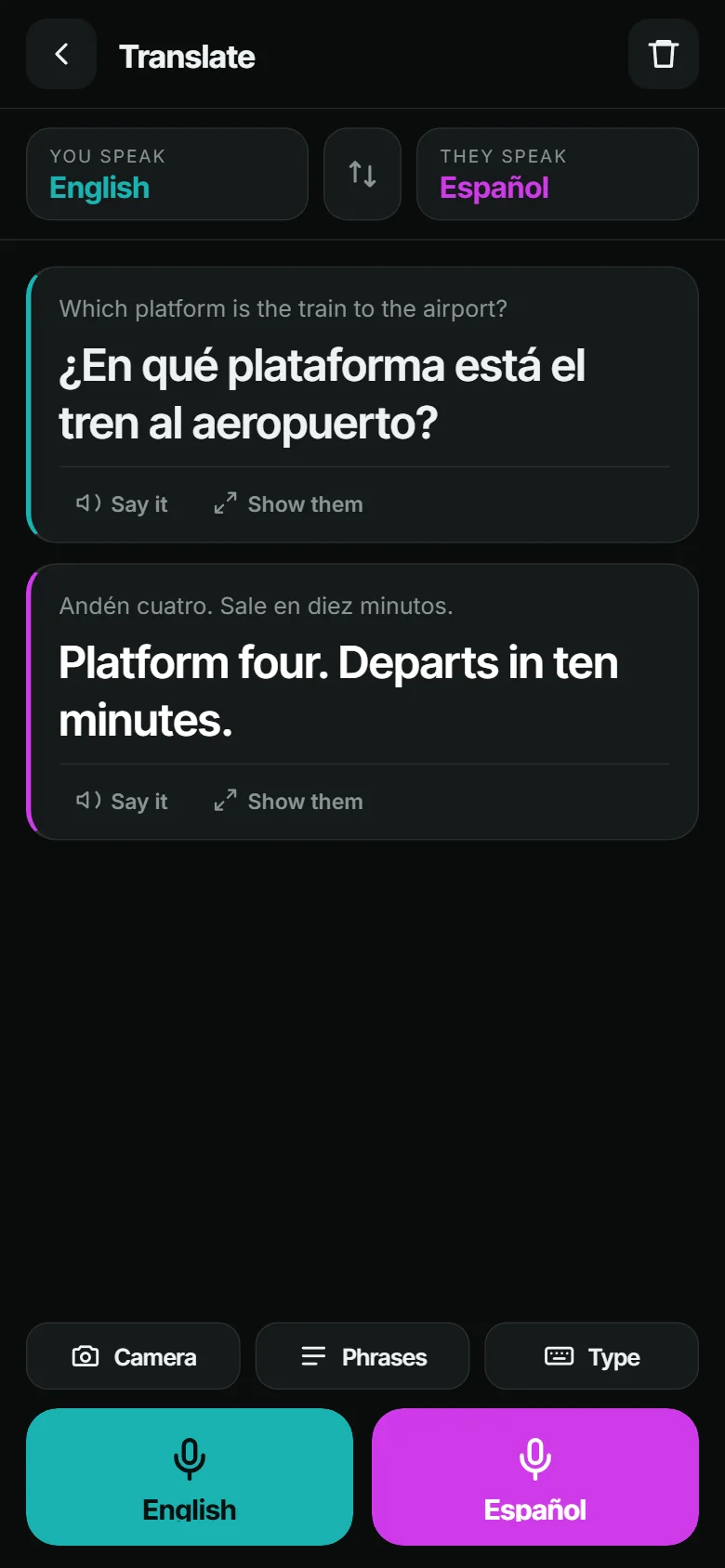
Translate mode: an English question, its Spanish answer, both read aloud
The voice carries over

32

languages. One voice. Theirs.

A translation app hands you a stranger's voice. Your bud doesn't change who they are to speak Spanish — the accent, the cadence and the temperature written into their Codex entry come with them. No new recordings were made for any of this. It is the same person, speaking a different language.

EnglishEspañolFrançais DeutschItalianoPortuguês NederlandsPolskiSvenska DanskNorskSuomi ČeštinaSlovenčinaHrvatski RomânăБългарскиΕλληνικά MagyarУкраїнськаРусский Türkçeالعربيةहिन्दी தமிழ்日本語한국어 中文Bahasa IndonesiaBahasa Melayu FilipinoTiếng Việt
One setting, every bud. Language belongs to you, not to the character. Set it once and whoever you're talking to speaks it — because someone travelling wants all of their buds in Spanish, not one Spanish bud.
Translate mode

Two people. One phone. Taking turns.

Two buttons, one for each language. Press yours and talk; press theirs and hand the phone over. Your bud says each line back in the other language, and "Show them" fills the screen with the translation in their script for a stranger to read. Missed it in a loud bar? Tap "Say it" again. Both lines stay on screen as text the whole time.

In translate mode the bud stops being a character and becomes an interpreter. No opinions, no reactions, no jokes — it translates and nothing else, so nobody is left wondering what the face just did.

Translate EN ⇆ ES
Your turn
Speak now
English · listening
Them · Español ¿Tiene una mesa para dos?
Kai · English Do you have a table for two?
Replay
Swap turn
Camera Auto detect
Detected · Japanese
自転車をおりてください
歩行者専用 · 自転車をおりてください
Pedestrians only.
Please dismount your bicycle.
Reading aloud
Photo translation

Point it at the sign.

A menu, a timetable, a form at a counter, a street sign you can't even guess at. Point the camera and your bud reads it and translates it in one pass — then says it out loud, so the person standing next to you hears it too.

You never tell it what language you're looking at. It works that out itself, which matters when you can't read the script well enough to know.

Navigation

"Navigate me home."

Say where you're going and the route draws, then your bud talks you through it turn by turn as you move — in their voice, in your language, while the street names stay in the local one.

Save the places that matter and "home" means your actual address, not a street somewhere called Home. That sounds small until you're tired, in the wrong city, and it matters more than anything else on this page.

Type a start as well as a destination and it measures a trip you haven't left for yet — distance, time and every turn, before you commit to it.
Navigate Driving
Kitana Keep going past the bridge — I'll tell you when to turn.
Home · saved
Hotel · Gion
End
Speak route
The difference

A translation app is a phone held out at someone.

The reason this works in a station and a hire-car desk and a pharmacy is not the accuracy. It's that there is a face doing the talking, and the person in front of you can look at it.

A translation app

  • A synthetic voice neither of you knows
  • You tell it what language you're looking at
  • A screen pushed across a counter
  • Closes when the conversation ends

Your bud

  • A voice with a personality, in 32 languages
  • Point the camera and it works the language out
  • A face that looks at the person in front of you
  • Still yours at the end of the trip
On the ground

Built for the places you actually need it.

The airport, at 6am

Gate changes, a form you can't read, a desk agent who's had a longer morning than you have. Ask once, out loud, and get an answer both of you understand.

The station, in a language you can't read

Platform boards translate from the camera, the route draws on the map, and your bud narrates the route while the street names stay local so the signs still match.

Text mode is the travel mode

No video stream: less battery, works on weak hotel wifi, and the transcript stays on screen in a loud terminal where nobody can hear anything.

The menu

Photograph it, get it back in your language, and ask them what's actually worth ordering. They'll have an opinion, because they always do.

They'll look it up

Opening hours, whether the place is still there, what the number is. They go and check rather than guessing, and hand you the actual link.

Where it's strongest. The speaking is the easy half — every one of the 32 sounds like your bud. Listening is done by your phone's own speech recognition, so European languages come through strongest, Japanese, Korean and Mandarin are solid, and a few of the smaller languages are still catching up. We'd rather tell you that than let you find out at a ticket window.

Take one with you.

The same bud you talk to at home is the one who orders your dinner in Kyoto.

See plans